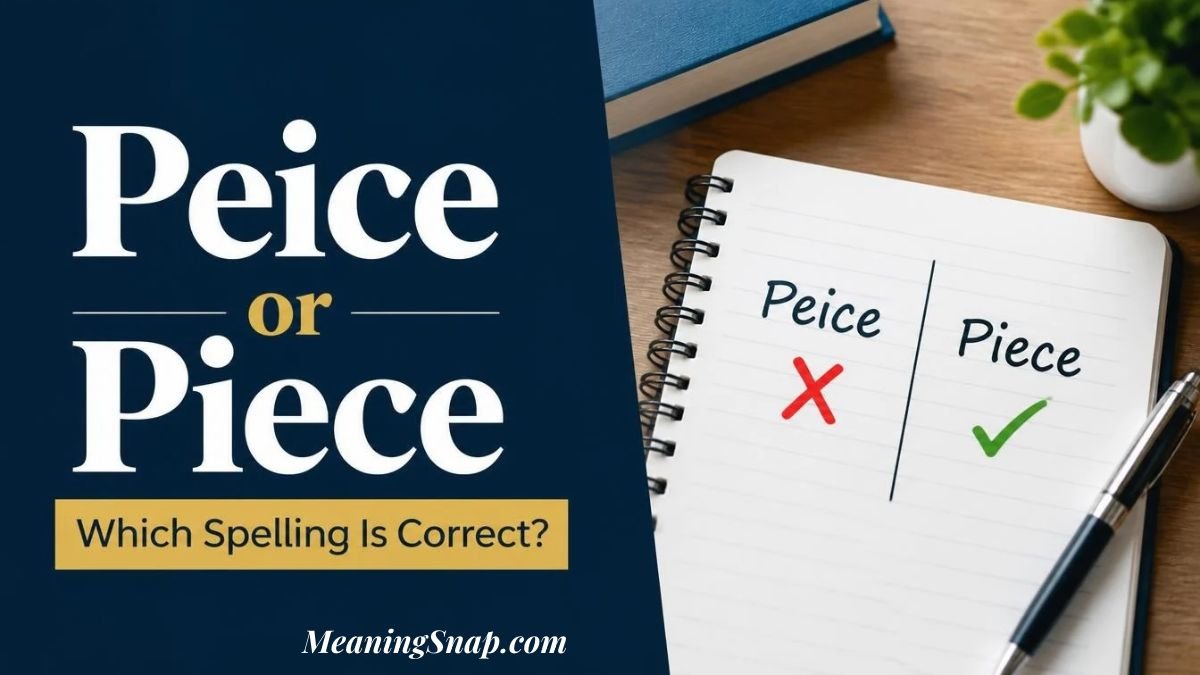
You’re texting a friend about dessert, and your thumbs stall over one word. Is it a peice or piece of cake? Both spellings look fine for about two seconds, then neither does.
The short answer is to write “piece.” The spelling “peice” is wrong everywhere, from group chats to term papers. Merriam-Webster’s entry lists no variant spelled this way, and the word follows the old “i before e” pattern, with i coming first.
Below, you’ll see why “peice” looks so convincing, what “piece” means, and how it behaves in art, movie titles, and idioms. You’ll also get the piece-versus-peace fix and a six-question self-test. The rules come from Merriam-Webster, Dictionary.com, Cambridge, and other named references, so you’re free to check the work yourself.
Peice or Piece: The Correct Spelling at a Glance
Whether you search piece or peice spelling, the answer stays put. This table sorts every form you’re likely to type.
| Spelling | Status | Why |
|---|---|---|
| Piece | Correct | The only spelling Merriam-Webster gives for the noun and the verb |
| Pieces | Correct | Plural noun, and the he/she/it form of the verb |
| Peice | Incorrect | Sits on common-misspelling lists, including Simple English Wikipedia’s |
| Peices | Incorrect | The same slip, carried into the plural |
| Peace | Real word, different meaning | Sounds identical to piece but means calm or harmony |
Dictionaries agree here, so there’s no US versus UK split to sort out. Merriam-Webster and Oxford Learner’s both use the ie spelling, and the vowels never trade places in “pieces,” “pieced,” or “piecing.”
You Also Like: Cocoon or Cacoon? Which Spelling Is Correct?
Why “Peice” Looks Right in the Peice or Piece Debate
Blame the sound. The vowel in “piece” is a long “ee,” and English spells this sound a dozen ways. Dictionary.com points to caffeine, leisure, seize, and weird, which all sound like a long e but wear an e-then-i spelling. Your brain stores “ie” and “ei” as one fuzzy blob and hands you whichever one it grabs first.
Typing makes it worse. Two neighboring letters in the wrong order is a classic thumb slip, and “peice” is exactly this slip. Autocorrect catches it most of the time. When it misses, the typo looks odd for a second, then looks fine.
“Looks fine” isn’t evidence, though. Merriam-Webster lists no such spelling, and Writer’s list of frequently misspelled words pairs “piece” with “peice” as the correct form and its common slip.
Peice or Piece: What the i Before e Rule Says
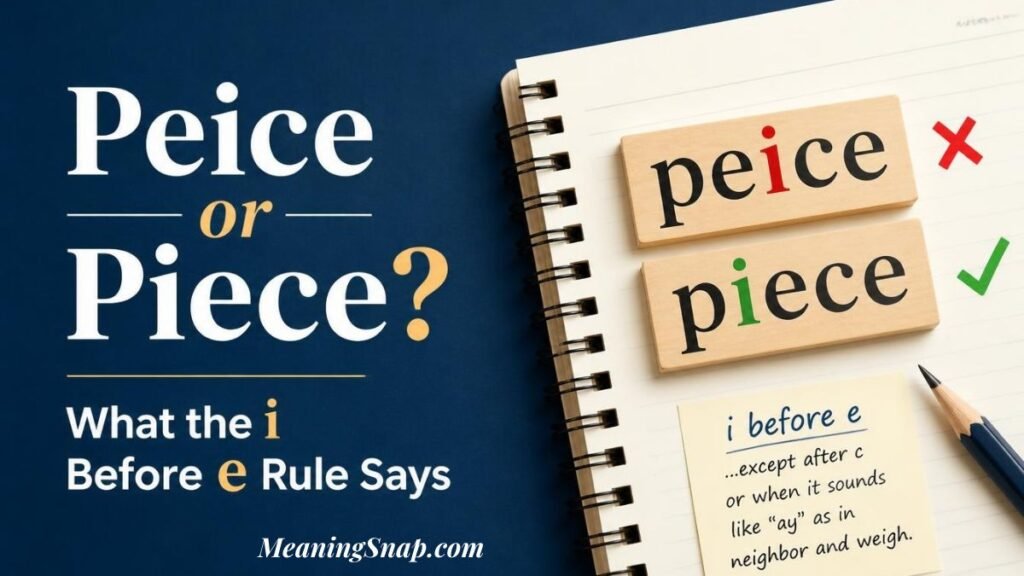
You learned the rhyme in school: “i before e, except after c.” The word “piece” obeys the first half. The i comes before the e, no c sits in front, and the vowel sounds like a long e. Compare “receive” and “ceiling,” where a c comes first, and the letters flip.
Here’s the thing, though. Merriam-Webster says the rhyme only reliably covers one category of words, the long e group including receive and conceited. To make the rhyme accurate, Merriam-Webster notes it needs extra lines for words like seize and height. Dictionary.com lists caffeine, leisure, seize, and weird as rule-breakers.
Think of the rhyme as a hint, not a law. For “piece,” the hint happens to work. For everything else, check the dictionary.
Read More: Chief vs Cheif: Which Spelling Is Correct?
Peice or Piece Meaning: Noun and Verb Senses
The right word does more jobs than most people expect. This table covers the everyday senses listed by Merriam-Webster, each with one example.
| Job | Meaning | Example |
|---|---|---|
| Noun | A part broken, cut, or torn off a whole | She saved the last piece of pizza. |
| Noun | One item of a kind or set | Grab a piece of fruit for the road. |
| Noun | A standard unit in which goods are made or sold | The lumber sells by the piece. |
| Noun | Something made, composed, or written | The paper ran a piece on school lunches. |
| Noun | A chessman other than a pawn | He lost a piece in the first ten moves. |
| Noun | A coin | A fifty-cent piece rolled under the couch. |
| Noun | An instance or example | The final scene was a nice piece of acting. |
| Verb | To join into a whole, often with “together” | We pieced the timeline together before class. |
Merriam-Webster keeps the chess sense narrow, so pawns sit outside it. The coin sense shows up in the kids’ entry as a “50-cent piece.”
The word has a long past. Merriam-Webster traces it through Middle English and Anglo-French to Vulgar Latin pettia, a reconstructed form of Gaulish origin, related to Welsh peth, meaning “thing.” The first recorded use dates to the 13th century.
Peice or Piece in Real Sentences
In the peice or piece mix-up, correct examples teach faster than rules. Seven of them, across texts, email, captions, school, and work, show the word in action. Each gets one short note.
- Text message: “Save me a piece of cake, I’m ten minutes away.” This is the plain portion sense, one slice.
- Email: “Please send the last piece of the report by Friday.” Here, piece means one section of a bigger whole.
- Caption: “Every piece of this road trip was worth the drive.” The word points to each separate part.
- School: “Our group will piece the slides together before class.” As a verb, piece means to assemble.
- Work: “Please review this piece before it goes live.” In an office, a piece is often an article or a design.
- Group chat: “One piece of the puzzle is still missing.” It fits jigsaws and mysteries alike.
- Friendly nudge: “Here’s a piece of advice: charge your phone tonight.” The word counts something uncountable, which a later section explains.
Next, three wrong-to-right pairs show where the typo sneaks in.
| Incorrect | Correct | What changed |
|---|---|---|
| I’d love a peice of pie. | I’d love a piece of pie. | The i goes back before the e |
| Our team will peice the report together. | Our team will piece the report together. | The verb uses the same spelling |
| These peices of furniture are on sale. | These pieces of furniture are on sale. | The plural keeps ie too |
Peice or Piece of Art: Is “Piece of Art” Correct?
Yes. Merriam-Webster’s entry for “piece” includes something made, composed, or written, and its thesaurus lists an artistic production among the senses. Wikipedia’s entry on works of art also names “art piece” and “piece of art” as labels for an artistic creation.
The four common labels differ in tone, not correctness. This table sorts them.
| Phrase | Tone | Example |
|---|---|---|
| Piece of art | Everyday, casual | I bought one piece of art for the hallway. |
| Art piece | Casual and compact | The art piece in the lobby is huge. |
| Work of art | Usually more formal, often praise | Her wedding cake was a work of art. |
| Artwork | One word, for one item or many | The artwork arrives Monday. |
Whichever phrase you pick, “piece” keeps its ie. In a gallery caption, the peice or piece slip stands out fast.
Peice or Piece in Movie Titles: One Piece and Period Pieces
Titles are where a typo shows most. “One Piece” is the name of Eiichiro Oda’s manga, serialized in Weekly Shōnen Jump since July 22, 1997, according to Wikipedia. The franchise now includes anime and films. The title also names the treasure the pirates chase in the story. It carries the ie spelling, so “One Peice” is a misspelling.
Film talk has its own term, “period piece.” Merriam-Webster defines it as a work whose special value lies in evoking a historical period, and dates its first known use to 1909. Oxford Learner’s narrows it to a play or film set in a particular period of history. For example: “We watched a period piece set in 1920s Paris.” The plural is “period pieces.”
Typing a title into a caption or hashtag? Copy the spelling from the official page, then settle the peice or piece question with a glance at the ie.
“A Piece of Advice”: How Piece Counts Uncountable Nouns
Here’s a snag for English learners. Many languages count words like advice, news, and information. English doesn’t. Cambridge Dictionary’s blog explains advice and information are uncountable, so they take no “a” or “an” and no plural s. The British Council’s LearnEnglish puts furniture, equipment, luggage, and news in the same group, and notes many of these nouns are countable in other languages.
“Piece” solves the problem. It works as a counter, giving you a single unit of something uncountable.
| Incorrect | Correct |
|---|---|
| She gave me an advice. | She gave me a piece of advice. |
| I need two informations. | I need two pieces of information. |
| It’s a good news. | It’s a good piece of news. |
| We bought three furnitures. | We bought three pieces of furniture. |
LearnEnglish adds spoken English often swaps in “a bit of,” as in “a bit of news.” Both work in conversation. In writing, “piece” is the safer pick.
Read Also: Knaw or Gnaw: Correct Spelling Explained (2026 Guide)
Peice or Piece vs Peace: Same Sound, Different Job
Piece and peace are homophones, which means they sound alike but differ in spelling and meaning. Once the peice or piece question is settled, this is the next trap. The table keeps the two apart.
| Word | Meaning | Example |
|---|---|---|
| Piece | A part, an item, or a created work | Pass me a piece of toast. |
| Peace | Calm, quiet, or freedom from conflict | The library offers peace and quiet. |
Both words fit in one sentence: “I’d trade this piece of cake for ten minutes of peace and quiet.” Say it out loud and the two sound identical, which is why spellcheck matters less than a quick read-through.
The biggest mix-up is the phrase “peace of mind.” It means a calm, worry-free state. Vocabulary.com and QuillBot both call “piece of mind” incorrect on its own. The only place “piece” sits next to “mind” is the idiom “give someone a piece of your mind,” which Merriam-Webster defines as a severe scolding.
Another pair trips people up. Merriam-Webster’s grammar notes separate “say your piece,” meaning state your opinion, from “hold your peace,” meaning stay silent. One uses piece, the other peace.
Spellcheck helps only halfway here. It flags “peice” because the spelling isn’t a word. Piece and peace are both real words, so a swapped one sails through.
How Do You Spell Piece of Cake? Idioms With Piece
Spell it p-i-e-c-e, then c-a-k-e: “piece of cake.” It means something easy to do. Merriam-Webster dates the phrase to 1935, and its exact origin isn’t settled. Skip “peace of cake,” because it swaps in the wrong word.
This table covers the idioms where “piece” shows up most.
| Idiom | Meaning | Example |
|---|---|---|
| Piece of cake | Something easy | The quiz was a piece of cake. |
| Piece by piece | One part at a time | She rebuilt the engine piece by piece. |
| Go to pieces | To lose control | He went to pieces after the news. |
| Piece of the action | A share in activity or profit | Investors wanted a piece of the action. |
| A piece of your mind | A severe scolding | She gave the driver a piece of her mind. |
Merriam-Webster lists “to pieces,” “piece of the action,” and “piece of one’s mind” as set phrases. In each one, the peice or piece answer stays the same: ie.
Peice or Piece: Memory Trick and a Quick Self-Test

For the peice or piece choice, memory tricks beat memorizing rules. Here’s the best one.
Memory Trick: Have a piece of pie. Pie holds the same i-then-e order as piece, and both are things you eat.
The same trick appears in Paul Brians’ Common Errors in English Usage from Washington State University. Two backup tests help as well.
- The swap test: replace the word with “part” or “slice.” If the sentence still works, spell it ie.
- The ease test: peace shares the letters “ea” with “ease,” and both mean relaxed calm.
Now try the quiz. Pick the right word for each sentence. Answers sit below.
- I’d love a (piece / peice) of pie.
- Give me some (peace / piece) and quiet.
- Our group will (piece / peace) the slides together.
- She finally has (peace / piece) of mind.
- He offered me a (piece / peice) of advice.
- Fans of (One Peice / One Piece) get the title right.
Answers: 1 piece, 2 peace, 3 piece, 4 peace, 5 piece, 6 One Piece. Five or six correct means you’re set.
Peice or Piece: Other i and e Misspellings to Watch
“Peice” has plenty of company. Writer’s frequently misspelled words list pairs “receive” with “recieve,” and Simple English Wikipedia’s list does the same job for other words. This table shows the slips worth catching.
| Correct word | Slip to avoid | What helps |
|---|---|---|
| receive | recieve | A c comes first, so e goes before i |
| believe | beleive | Long e sound, no c, so i goes first |
| achieve | acheive | Same pattern as believe |
| friend | freind | The vowel isn’t a long e, so memorize it |
| weird | wierd | A rule-breaker listed by Dictionary.com |
| seize | sieze | Merriam-Webster lists it as an exception |
The pattern is simple. When the sound is a long e and no c leads the way, i goes first. When it breaks, you’ve met an exception, and a quick dictionary check settles it.
FAQs
What is the plural of piece?
The plural is “pieces,” with the same ie spelling. “Peices” is wrong. With uncountable nouns, use “pieces of,” as in “two pieces of advice.”
Is “peice” an older or British spelling?
No. Merriam-Webster and Oxford Learner’s use “piece” on both sides of the Atlantic. “Peice” is an error, no matter which country you’re writing from.
How do you pronounce “piece”?
Oxford Learner’s transcribes it as /piːs/, the same as “peace.” This identical sound is why the two words get swapped in writing.
What is the difference between piece and part?
Merriam-Webster groups both under words meaning something less than the whole. “Part” is the general term, while “piece” usually points to a distinct bit or unit.
Why doesn’t spellcheck catch piece and peace?
Both are real words, so a spellchecker sees nothing misspelled. Only a read-through, or a grammar tool, flags the wrong one in context.
Peice or Piece: Pie First, Then You’re Done
Next time the peice or piece question freezes your thumbs, think of pie. The i comes first in pie and in piece, and “peice” never earns a spot. If the sentence is about calm, switch to peace. Spell it right once, and you’ll stop second-guessing it.

Alex Morgan is a writer focused on explaining slang, words, phrases, acronyms, and popular expressions in a simple and easy-to-understand way. Through clear explanations and helpful examples, Alex helps readers quickly understand what words and phrases mean and how they’re commonly used.