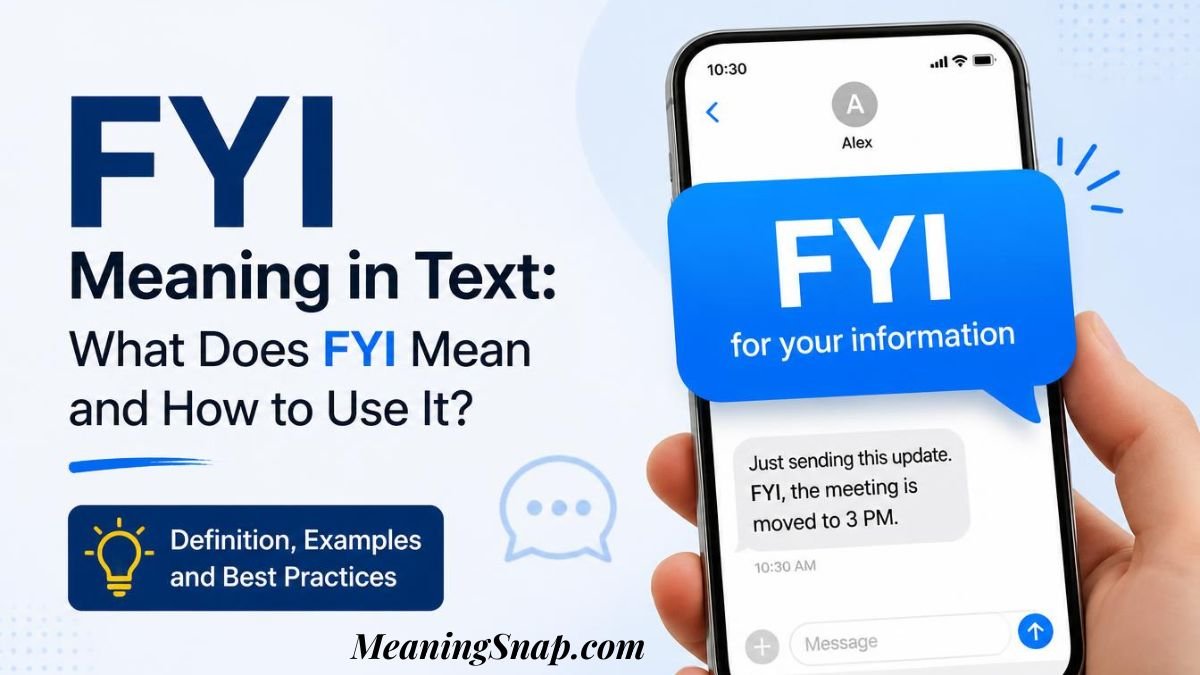
Your coworker sends you a one-line text: “FYI, the meeting got moved to 3pm.” No greeting, no explanation, just that. You stare at it for a second, wondering if you missed something or if they’re annoyed with you. You didn’t miss anything. That’s just how FYI meaning in text works, it’s a quick, no-fuss way to pass along a fact.
FYI shows up everywhere, in work emails, group chats, and casual texts from friends. But the tone behind it can shift depending on who’s sending it and how they send it. Here’s everything you actually need to know about it.
What Does FYI Mean?
FYI stands for “for your information.” It’s used when someone wants to share a fact or update in a chat, DM, or email without expecting a reply. Think of it as a verbal tap on the shoulder. The sender isn’t asking a question or starting a conversation, they’re just passing something along because they think you should know it.
The FYI meaning in text hasn’t really changed since it moved from paper memos to phone screens. It’s still doing the same job: delivering information fast, with zero small talk attached.
Quick Answer: FYI means “for your information.” It’s used to share a fact, update, or heads-up without expecting a response. You’ll see it in texts, emails, DMs, and group chats, and it can read as neutral, helpful, or blunt depending on the context.
What makes FYI interesting is how flexible it is. The same three letters can sound completely different depending on punctuation, tone, and who’s on the other end of the phone. A parent texting “FYI, dinner’s at 7” reads nothing like a coworker texting “FYI, you were cc’d on that email by mistake.” Same acronym, very different energy.
It’s also one of the rare texting abbreviations that every generation understands the same way. Gen Z didn’t reinvent the FYI meaning in text the way it has with other slang, it just kept using the term exactly as older generations already had. That’s fairly unusual for internet shorthand, most of it drifts or gets reused with a totally new spin over time.
You also Like: FW Meaning in Text: What Does “FW” Mean in Chats, Social Media, and Online?
Where Did FYI Come From?
FYI didn’t start on phones. It started in offices, decades before texting existed. Business memos and internal notes used “FYI” as shorthand to flag information that didn’t need action, just awareness. Someone would jot “FYI” at the top of a document before routing it to a coworker who needed to see it but didn’t need to respond.
When email became the standard for workplace communication in the 1990s, FYI carried over almost unchanged. It became one of the most common subject-line tags in office inboxes, right alongside “RE:” and “URGENT.”
Texting simply borrowed it. Once phones took over as the main way people communicate, FYI slid naturally into everyday chat because it already meant exactly what people needed: here’s something, no response required. Unlike a lot of internet slang that started on TikTok or Twitter, FYI has a paper trail that goes back to typewritten memos. That’s part of why it doesn’t feel like slang at all to a lot of people, it feels like plain English that happens to be abbreviated.
Most language references generally trace FYI’s earliest documented use back to American business correspondence from the mid-20th century, well before computers, let alone smartphones, were part of daily work life. That long history is a big part of why the FYI meaning in text stayed so stable. It never went through the meme-driven reinvention that terms like “lit” or “salty” did, it just moved from paper to screens with its job unchanged.
How to Use FYI in a Sentence
FYI is easy to use, but the small details, like punctuation and placement, change how it reads. Most people write it in all caps, though lowercase “fyi” is common in casual texting. A comma usually follows it when it starts a sentence, though plenty of texters skip the comma entirely for a more clipped, casual feel.
It works at the start, middle, or end of a message:
- “FYI, I won’t be online after 6.”
- “Just so you know, and FYI, this offer ends tonight.”
- “The store closes early on Sundays, FYI.”
Here’s how that plays out in real conversations:
Text from a friend: “heading out now, fyi it’s raining so bring a jacket”
Text from a coworker: “FYI I sent the revised deck to the client an hour ago.”
Text from a parent: “FYI your package arrived, it’s on the counter.”
Notice none of these ask a question or invite a back and forth. That’s the core of the FYI meaning in text, it’s a one-way delivery of information. You can respond if you want to acknowledge it, but the sender isn’t sitting there waiting on a reply.
In more formal writing, like a cover letter or a client email, it’s usually better to spell out “for your information” the first time and save “FYI” for follow-up messages once the tone’s already been set as casual. That small adjustment keeps a professional email from feeling like a text message that wandered into the wrong inbox.
FYI Across Texting and Social Apps
FYI doesn’t change meaning from app to app, but the tone around it shifts depending on where you see it. A quick look at how it typically shows up across platforms makes the pattern pretty clear.
| Platform | Common Usage | Typical Tone |
|---|---|---|
| Instagram DMs/Comments | Sharing a fact about a post, product, or plan | Casual, sometimes blunt |
| Snapchat | Quick heads-up before a Snap disappears | Fast, informal |
| TikTok Comments | Correcting or adding info under a video | Direct, occasionally sarcastic |
| WhatsApp Groups | Logistics updates (time changes, cancellations) | Practical, neutral |
| Work Email/Slack | Flagging info that needs no action | Professional, efficient |
The pattern across every platform is the same: FYI signals “here’s a fact, do with it what you want.” What changes is how much warmth surrounds it. A work Slack message might pair FYI with formal phrasing, while a Snapchat caption might just be “fyi im not coming lol.” The underlying FYI meaning in text stays constant even as the vibe around it shifts from professional to playful.
One thing worth noting on TikTok and Instagram specifically: FYI often shows up in comment sections as a polite (or not-so-polite) correction, like “FYI that’s not actually how that works” under a video. It’s doing the same job it always does, just with an audience watching.
Group chats deserve a special mention here too. In family threads, roommate chats, or friend groups, FYI often gets used to update everyone at once without expecting each person to respond individually, like “FYI the wifi password changed” or “FYI I moved the reservation to 8pm.” It’s efficient in a group setting because it signals the message is informational, not a discussion starter, which cuts down on a chat filling up with unnecessary replies.
Also Read: CYA Meaning in Text: What It Actually Means (and When to Use It)
FYI Meaning on Instagram
FYI meaning in Instagram works the same as anywhere else, but where it shows up changes the read. In DMs, it usually plays like a quick personal update, something like “fyi I’m posting that pic later today.” In comments, it tends to correct or add information under someone else’s post, like “FYI this recipe needs more salt than the caption says.” On Stories, people often drop FYI into the caption text over a photo or video to flag something practical before it disappears, something like “fyi link expires tonight” layered over a swipe-up sticker.
None of these change what FYI actually means. What shifts is the audience. A DM is private and one-on-one, a comment is public and can invite pushback, and a Story reaches a wider crowd but usually doesn’t expect direct replies at all.
FYI Meaning on TikTok
On TikTok, FYI shows up almost entirely in comment sections, and it tends to carry more of an edge than it does on Instagram. Comments are public and often visible to thousands of people, so an FYI reply under a video reads more like a correction aimed at an audience than a private heads-up. A comment like “FYI that ‘life hack’ doesn’t actually work” is doing double duty, informing the original poster and everyone scrolling past at the same time.
That public element is exactly why FYI meaning on TikTok can land as blunt even when the commenter means well. There’s no private message softening the delivery, just three letters and a fact, sitting in a thread anyone can screenshot and share.
FYI Meaning on Facebook and Messenger
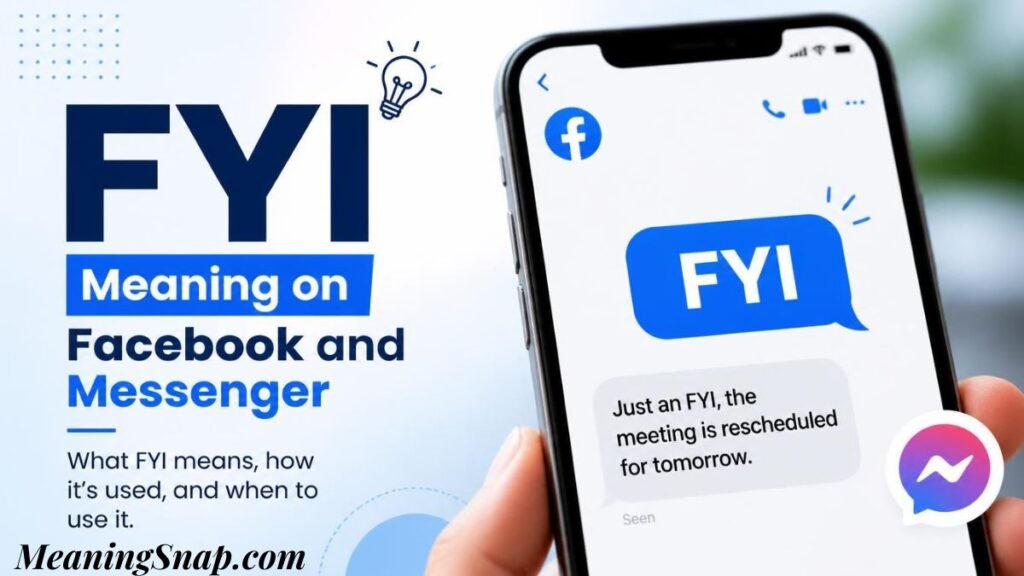
Facebook skews toward an older, more mixed-age audience than Instagram or TikTok, and FYI usage reflects that. In Facebook posts and comments, it often shows up in a neutral, almost old-school way, similar to how it reads in an email, like “FYI the community yard sale got rescheduled to Saturday.”
In Messenger specifically, FYI functions closer to a text message than a public post. It’s common in group chats for logistics, planning, or reminders, something like “FYI I already RSVP’d for both of us.” The tone on Messenger usually lands warmer than TikTok or Instagram comments, mostly because Messenger conversations tend to happen between people who already know each other well.
Read More article: HMU Meaning in Text: What Does HMU Mean?
FYI Meaning in Work Chats and Emails
Work is where FYI shows up the most consistently, and it carries the least ambiguity there. In professional settings, FYI signals one thing: here’s information relevant to you, no action required on your end. It’s common in email subject lines (“FYI: Updated Vendor List”), inside the body of a message, or as a quick note in Slack or Teams before forwarding a thread along.
A few real examples from typical office chat:
- “FYI, I looped in Sarah since this affects her team too.”
- “FYI, the client pushed the deadline to Friday.”
- “FYI, that link in the last email was broken, here’s the fixed one.”
Because workplace communication depends on clarity, this is also the setting where FYI meaning in work chats is least likely to get read as rude. Most people understand it as shorthand for efficient information sharing, not commentary or judgment.
FYI Meaning From a Guy or a Girl

A lot of people search this hoping FYI carries some hidden meaning depending on who sends it. It doesn’t. FYI meaning from a guy or FYI meaning from a girl works exactly the same, it’s not a flirty term, a subtweet, or a coded message. If it feels loaded, that’s coming from the relationship and the surrounding conversation, not the acronym itself.
That said, the same three letters can read differently depending on the emotional context. In a new dating situation, an FYI text like “FYI I have plans Friday but I’m free Saturday” is just a scheduling update, not a signal about how someone feels. In an argument, an FYI like “FYI you’re the one who canceled last time” carries a defensive edge, but that’s the sentence around it doing the work, not the word FYI itself.
The same logic applies to FYI meaning in love or inside a relationship text thread. It’s still informational at its core. If someone’s using it to communicate feelings, they’re layering that meaning on top of FYI, not pulling it out of the acronym.
FYI Meaning in a Funny Text
FYI works well for jokes because it borrows the tone of a serious announcement and applies it to something ridiculous. That contrast is basically the whole joke. Texting a friend “FYI I will not be sharing my fries” or “FYI I’m blaming you if this plan fails” uses the flat, official-sounding structure of FYI to deliver something silly instead of something serious.
This works especially well in group chats, where a fake-serious FYI can land as deadpan humor. “FYI, I’ve decided we’re getting tacos and this is not up for debate” reads funny specifically because FYI usually announces boring, practical facts, not declarations. Using it for something dramatic or exaggerated is exactly what makes it land as a joke.
Is FYI Rude or Polite?

This is where most of the confusion around FYI comes from. The word itself is neutral. Context decides whether it lands as considerate or curt.
FYI tends to read as polite when it’s genuinely helpful and the sender clearly means well. A friend texting “FYI, that restaurant’s closed on Mondays” before you head out is doing you a favor. A coworker flagging “FYI, the doc has a typo in section 2” is saving you a headache. In both cases, the information itself is the point, and there’s no edge to it.
It starts to feel rude in a few specific situations. If someone uses FYI to correct you publicly instead of privately, it can come off as showing off or calling you out. If it’s used as a passive-aggressive way to state an opinion, like “FYI, that’s not how you’re supposed to load a dishwasher,” it stops being informational and starts being a jab dressed up as a fact. Tone of voice doesn’t exist in text, so a flat “FYI” with no softening language can read colder than the sender intended, even when they meant nothing by it.
Punctuation and follow-up matter too. “FYI :)” or “FYI, just thought you’d want to know!” softens things considerably compared to a bare “FYI.” plus nothing else. Writing it in all caps with an exclamation point, like “FYI!! you left your charger here,” can also read as more urgent or annoyed than intended, even when the sender just meant to grab attention. Since the acronym carries no built-in emotion, everything around it, punctuation, emojis, timing, does the heavy lifting on tone.
Read More Article: MK Meaning: What Does MK Mean in Text?
FYI vs. Similar Abbreviations
FYI belongs to a small family of texting acronyms that all deliver information, but each one carries a slightly different job. Knowing the differences helps you pick the right one for the situation, or figure out what someone actually meant when they used one over another.
| Term | Meaning | When People Use It Instead of FYI |
|---|---|---|
| BTW | By the way | Adding a minor, related side note mid-conversation |
| PSA | Public service announcement | Sharing info meant for a group, often with a bit of humor |
| JIC | Just in case | Giving a precaution or backup plan, not just a fact |
| TBH | To be honest | Sharing an opinion, not neutral information |
| NGL | Not gonna lie | Similar to TBH, used before an honest or blunt take |
The clearest distinction is between FYI and BTW. FYI usually opens a new piece of information on its own. BTW tends to tack something onto an existing conversation, almost like an afterthought. “FYI, I’m running late” stands alone. “BTW, I’m running late too” fits into a thread that’s already happening. PSA leans more public and often has a slightly joking tone, while TBH and NGL are built for opinions, not facts, which puts them in a different lane entirely from the strictly informational FYI meaning in text.
Common Mistakes People Make With FYI
FYI is simple, but people misuse it in a few predictable ways. The most common mistake is using it to soften an unsolicited opinion, like “FYI, I think you’re overreacting.” That’s not information, that’s a judgment wearing an FYI costume, and it usually lands worse than just saying the opinion directly.
Another mistake is overusing it. When every single text starts with “FYI,” it loses its purpose and starts sounding robotic instead of natural. FYI works best when it flags something the other person genuinely didn’t know, not as a filler word attached to routine chatter.
Some people also use FYI as a stand-in for an apology, saying something like “FYI, I already told you that” when what they actually mean is “I’m annoyed you forgot.” That mismatch between the words and the real intent is exactly what makes FYI feel rude in the wrong context, even though the acronym itself carries no attitude on its own.
Finally, plenty of people just misread tone that isn’t there. A flat, factual FYI text isn’t automatically cold, sometimes it’s just efficient. Reading hostility into every bare-bones FYI message says more about the reader’s mood than the sender’s intent.
There’s one more misstep worth flagging: using FYI to deliver news that actually needs a real conversation, like “FYI, I’m moving out at the end of the month.” Big, life-changing information deserves more than an acronym built for quick, low-stakes facts. When the news carries real weight, the FYI meaning in text can end up making a serious update feel dismissive, even if that’s not what the sender intended.
Do You Need to Reply to FYI?

Short answer: usually not. Part of the FYI meaning in text is built around being a one-way message. The sender is passing along information, not opening a question, so a reply is optional rather than expected.
That said, a quick acknowledgment is common and often appreciated, especially in group chats or work settings where silence can look like the message got missed. A simple “got it” or “thanks for letting me know” closes the loop without turning it into a whole conversation. In more casual friend-to-friend texting, a thumbs-up reaction or a one-word “ok” does the same job.
Here are a few reply styles depending on the setting:
Casual reply: “got it, thanks!”
Formal reply: “Thanks for the update, noted.”
No reply at all: Completely acceptable if the FYI didn’t require action and the sender wasn’t waiting on you.
Sarcastic reply (between friends): “wow, breaking news 📰”
In work chats especially, a short acknowledgment is worth sending even when it’s not strictly necessary. It confirms the message landed and prevents the sender from wondering if it got buried. Outside of work, whether you reply at all usually comes down to your relationship with the person and whether the update actually affects your plans.
Slack and email culture tends to be a bit more reply-happy than texting. A one-word “noted” or a thumbs-up emoji reaction is standard practice in most workplaces, mostly because it shows the message didn’t get lost in a busy channel. Texting between friends has looser norms, and plenty of people leave FYI messages completely unanswered without anyone thinking twice about it.
FAQs About FYI Meaning in Text
What does FYI mean in text?
FYI stands for “for your information.” It’s used to share a fact or update quickly, without expecting a response.
Is FYI flirty?
Not typically. FYI is informational by design, so it doesn’t carry romantic undertones on its own. Any flirty feel comes from the surrounding conversation, not the acronym itself.
What’s the difference between FYI and BTW?
FYI usually introduces a new, standalone piece of information, while BTW tends to add a related side note onto a conversation that’s already happening.
Is it rude to text someone just “FYI” with nothing else?
Not inherently, though a bare FYI with no softening words can read as blunt or cold depending on the relationship and the topic. Adding context or a friendly tone usually smooths it out.
Can FYI be used to start a formal email?
Yes. FYI is common in professional emails, often as a subject line tag or an opening phrase before a routine update that doesn’t need action.
Is FYI still commonly used, or is it outdated?
It’s still widely used across texting, social apps, and workplace communication. Because the FYI meaning in text is so straightforward, it hasn’t gone out of style the way some slang trends have.
Do I always need to respond to an FYI text?
No. FYI messages are meant to inform, not to start a back-and-forth, so a reply is optional unless the situation calls for confirmation.
Does FYI mean “for your interest”?
No. FYI stands for “for your information,” not “for your interest.” The mix-up is common since “interest” sounds plausible, but the original and correct meaning has always been about sharing information, not gauging someone’s interest.
The Bottom Line on FYI Meaning in Text
FYI has stuck around for decades because it does one job and does it well, it hands over information without asking for anything back. Whether it shows up in a work email, a group chat, or a comment under a TikTok video, the core meaning never really moves, only the tone around it does. Once you can read that surrounding context, a bare “FYI” stops feeling confusing or loaded and just becomes what it’s always been, a fast, low-effort way to keep someone in the loop. Next time an FYI text lands in your inbox, you’ll know exactly what it’s doing there, and exactly how much of a reply it actually needs.

Alex Morgan is a writer focused on explaining slang, words, phrases, acronyms, and popular expressions in a simple and easy-to-understand way. Through clear explanations and helpful examples, Alex helps readers quickly understand what words and phrases mean and how they’re commonly used.